

Esteemed readers:
I am sending you this image that is part of a series of engravings called Thesaurus Philo-Politicus, published by Daniel Meisner in collaboration with Eberhard Kieser from 1623.
This engraving is entitled…
…EX VITIO ALTERIUS SAPIENS EMENDAT SUUM
‘From the error of others, the sage amends his own’
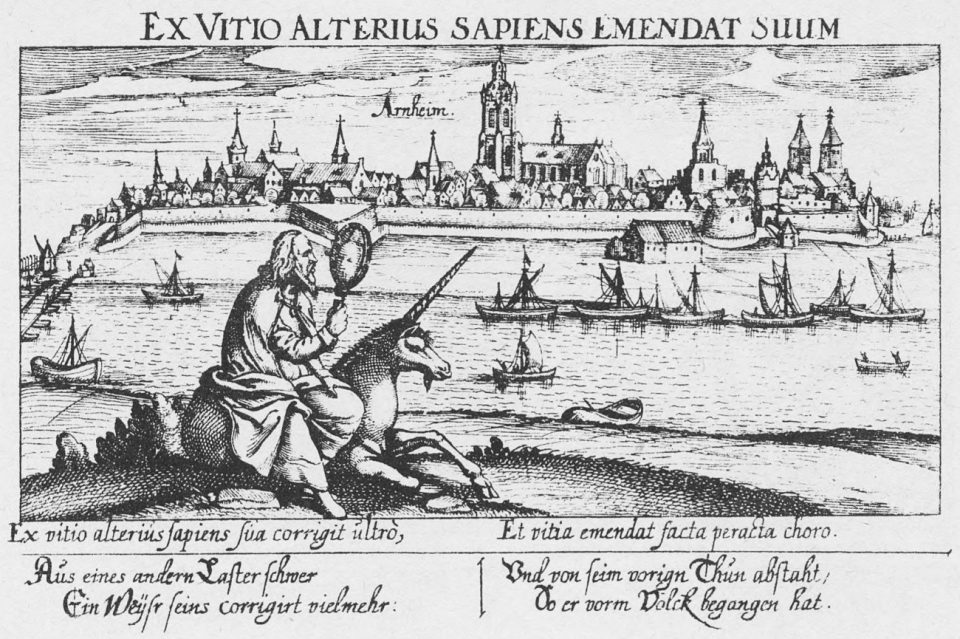
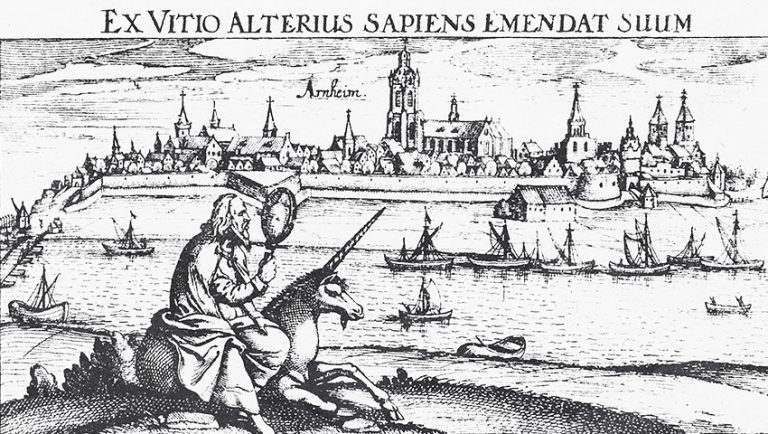
In the foreground we see a sage looking at himself in a mirror and riding a unicorn. In the background is the panorama of the city of Arnhem ─Netherlands─.
Ex vitio alterius, sapiens sua corrigit ultro,
Et vitia emendat facta peracta choro.
Translation: ‘From the error of others, the sage corrects his own spontaneously, and amends errors made and carried out in front of the multitude.’
The Old German text states the same thing: ‘From the vices of others, the sage corrects his own even more; and stops repeating his old deeds ─mistakes─ that he had made before the world’.
What is all of this meant to tell us, dear reader?
First, we must begin by pointing out that this engraving alludes to the alchemical art. That is why we see the alchemist looking at himself in a mirror, and this brings us to the topic directly related to the subject that speaks to us: the mirror of Alchemy.
In this regard, in the preface to The Dwellings of the Philosophers there are things like these:
“The mirror of wisdom, evidently, offers no relation to the furniture used for the reflection of the image, even if it is made of metal, as in ancient Egypt, or of obsidian, as in the Rome of the Caesars, or of the crystal of the fountains, in the remotest origins, or of the purest quicksilver glass in our modern times. However, it is the latter, in the form of a convex and inclined lens, that holds Prudence with two opposite faces, guardian of the tomb of Francis II of France, in the cathedral of Saint Peter, in Nantes, with her three companions: Justice, Fortitude and Temperance.
[…]
“In the kingdom of sulfur,” insists the Cosmopolitan, “there is a mirror in which the whole world is seen. Whoever looks in that mirror can see and learn the three parts of the wisdom of the whole world, and in this way he will become very wise in those three kingdoms just as Aristotle, Avicenna, and many others were, who, like the rest of the masters, saw in that mirror how the world was created.” ─De Sulphure, Coloniae, 1616, p. 65.─
Surely, the double secret of birth and death, impenetrable to the wisest “according to the century”, that of the creation of the world and of its tragic end in punishment for the equally immeasurable greed and pride of men, are not the smallest visual revelations that the Mirror of the art provides to the adept.”
Later V.M. Fulcanelli adds the following in the same work The Dwelling of the Philosophers:
“But while the dragon represents the scaly and volatile mercury, the product of the superficial purification of the subject, the snake, deprived of wings, remains the hieroglyph for the common, pure and cleansed mercury, extracted from the body of Magnesia, or first matter. This is the reason why certain allegorical statues of Prudence have as an attribute the snake fixed on a mirror. And this mirror, signature of the dross mineral provided by nature, becomes luminous while reflecting the light, that is while manifesting its vitality in the snake, or in mercury, which it held hidden under its coarse envelope.”
The Venerable Master Samael, in his work THE SECRET DOCTRINE OF ANAHUAC, tells us things like these when he speaks to us of the mirror of Alchemy, let us see:
“When the Blessed one ─referring to Quetzalcoatl─ reached the red-colored land, he put on his shoulders the purple of the divine kings and resurrected from among the dead.
They say that he saw himself then in the waters as in a mirror –the mirror of Alchemy. His face was beautiful again –he returned to the lost Paradise. He dressed himself with the most beautiful clothing and, having lit a bonfire, he threw himself into it –the sexual Fire finished off completely his psychological “I”, not even his ashes remained–; and the birds of rich plumage –the birds of the Spirit– came to see how it burned: the red-breasted bird, the turquoise-colored bird, the sunflower bird, the red-and-blue bird, the golden-yellow bird and a thousand other precious birds. When the bonfire ceased to burn ─the Great work has been consummated─ his heart rose, and it reached the heavens. There he changed into a star, and that star is the morning and twilight star. Before, he had gone down to the realm of the dead and, after seven days of being there, he rose, transformed into a star.
The Initiator always presents us the mirror of Alchemy in one hand, while holding the Amalthea’s horn in the other. At his side, we see the Tree of Life so studied by the Hebrew Kabbalists. The mirror always symbolizes the beginning of the Work, the Tree of Life indicates its end and the horn of abundance, the result.”
CONCLUSION:
Companions, the mirror of Alchemy refers to the transformations that our transmutations bring about in us. It is the mirror of Alchemy that totally transforms the lives of the Adepts and turns them into special beings through the wonderful powers of the Mercury of the philosophers.
Perhaps that is why we also see the Adept sitting on a unicorn ─symbol of absolute chastity─, while he is looking at himself in the mirror of Alchemy.
In the background of this illustration we see several sailboats that symbolize the various reiterations made by the Adept in his work of the laboratorium.
I now add a few quotations for your reflection:
“Christianity has all too often confused chastity with prudence. True purity is that of love. A eunuch or a seminarian may not be chaste at all: the smile of a fiancée may be infinitely more virginal than that of a nun.”
Guyau
“Purity, like opal, is considered insignificant because its reflections are not seen.”
Carmen Silva
“There is no purity other than the first, and once it is lost, it is lost forever.”
Concepción Arenal
“One aspect of prudence is that what can be done for good should not be used for evil.”
Cervantes
“He who has prudence does not need a protector.”
Juvenal
PHILOSOPHIA ANCILLA THEOLOGIAE.
─‘Philosophy is the servant of theology’─.
KWEN KHAN KHU