

Dearly beloved readers:
We are sending you a very interesting engraving from the alchemical point of view entitled…
…EMBLEMA 5 – AVRI POTABILIS CHIMICE PRAEPARATIO
─’EMBLEM 5 – ALCHEMICALLY PREPARED POTABLE GOLD’─
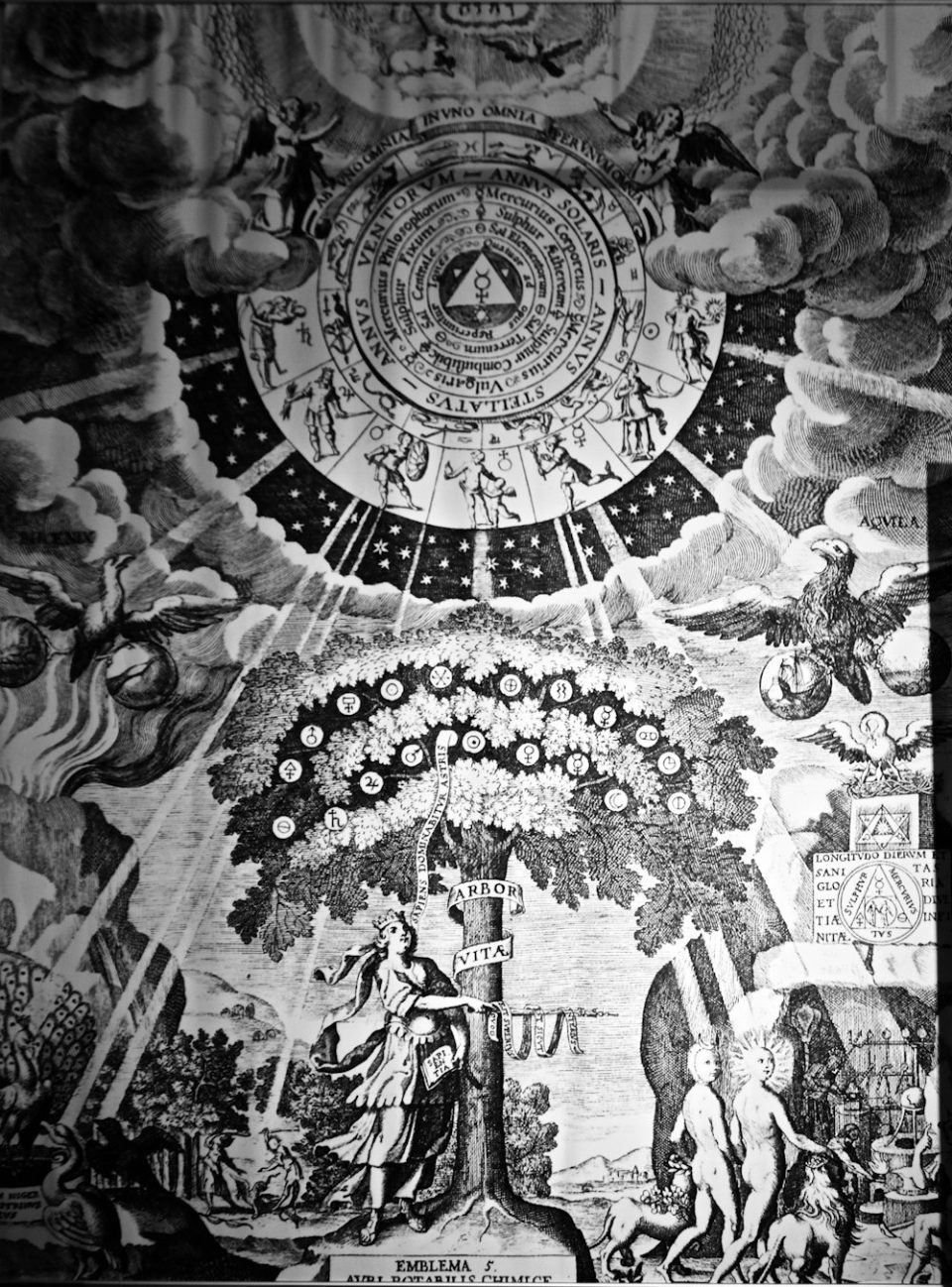
This engraving was made by the German artist Wolfgang Kilian (1581-1662) and was published in an alchemical and medical book written by the German physician Malachias Geiger (1606-1671) entitled Microcosmus Hypochondriaca Tractatus (1652) ‘The Hypochondriac Microcosm on Hypochondriac Melancholy’.
Here are some comments about the book:
“Geiger, who was a physician in Munich, treated hypochondria and melancholia, not only as ailments of the body, but as obscuration of the ‘inner sun.’ The book argues that the human being is a microcosm that reflects the order of the Universe; if the internal stars are in disorder, the body becomes ill. A large part of the chapters are dedicated to the preparation of AurumPotabile ─’potable gold’─, a perfect and “solar” metal, an alchemical remedy considered universal to treat the disorder known at the time as “hypochondriac melancholy”, a state that combines physical symptoms with psychological disorders ─anxiety, depression, fear─”.
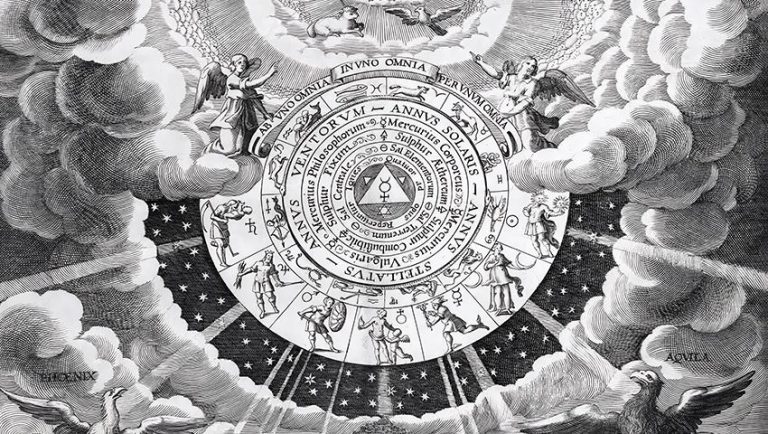
The image is known by the name of The Tree of Life, or, according to its Latin inscription: “EMBLEM 5 – AVRI POTABILIS CHIMICE PRAEPARATIO”, ‘EMBLEM 5 – ALCHEMICALLY PREPARED POTABLE GOLD’.
At the top of the drawing are depicted the forces of the Father ─his name is written in Hebrew: Yod He Vau He─, the Son ─the lamb─ and the Holy Spirit ─the dove─. The concentric circles, from which rays of light emanate across the starry sky, contain representations of the seven planets, the zodiacal belt, Latin words and, in the center, a circle with the Star of David, a triangle with the sign of Mercury and two other small triangles.
When we read the doctrine of our Patriarch, V.M. Samael Aun Weor, alluding to THE METALLIC PLANETS OF ALCHEMY, we see these comments reflected in it, according to which the influence of these stars, namely: the Moon, Mercury, Venus, the Sun, Mars, Jupiter and Saturn, determines the physical and metaphysical events in our existence, throughout our lives.
Latin words from the outer circle to the inner circle:
IN VNO OMNIA: ‘All in the One’. Unquestionably, dear friends, all creation has its origin in the THEOMEGALOGOS, the indivisible and eternal One; from there everything emanates through the seven cosmos.
AB UNO OMNIA: ‘Everything originates from the One.’ Undoubtedly, unity begets multiplicity.
PER VNVM OMNIA: ‘All by means of the One’. Reaffirmation of the power of the most holy Theomegalogos.
ANNVS VENTORVM: ‘Years of the winds’, allusion to the cyclical times that our humanity is experiencing in relation to the cosmic ages.
ANNVS SOLARIS: ‘Solar year’, referring to the time in which cosmic vibrations flood us with solar ideas.
ANNUS STELLATVS: ‘Sidereal year’, inherent to the time that a complete age lasts.
Mercurio corporeus: ‘Corporeal Mercury’, allusion to the first type of Mercury, raw quicksilver, Mercury in the animaloid state.
Mercurius Vulgaris: ‘Common Mercury’, second type of Mercury, metallic soul of the sperm.
Mercurius Philosophorum: Third type of Mercury, Gnostically called arché, the Mercury with which the vehicles of the Solar Man can be fabricated.
Sulphur Aethereum: ‘Ethereal sulfur’, referring to the invisible fire.
Sulphur Combustible: ‘Combustible sulfur’. The visible three-dimensional fire.
Sulphur Fixum: ‘Fixed Sulfur’, the Sacred Fire of Stella Maris ─Devi-Kundalini─.
Sal elementorum: ‘Salt of the elements’. All the elements of Nature carry within them the Salt of their own arché.
Sal terrenum: ‘Salt of the Earth’, the Salt that we find at the shores of the seas, at the base of volcanoes, etc.
Sal Centrale: ‘Central Salt’. It is the Salt of alchemical sublimation.
Quatour ad Opus Reperiuntur Ignes. Four fires are found for the work, namely: the common, infernal fire of the fornicating man; the fire of the man who comes to know the Arcanum A.Z.F.; the fire of the one who is transmuting his creative energies and the fire of the one who has already awakened his Kundalini.
To the right of the engraving appears an eagle ─AQVILA─ with two spheres in its talons. In one of these spheres we see a sailboat and in the other a landscape with a mountain. The eagle, alchemically, alludes to the volatile element ─the Mercury of the sages─. The mountain symbolizes the spiritual heights that we can conquer in our hermetic journey.
The sailboat represents the reiterations of the work on the Arcanum or alchemical journeys.
On the left we can see a Phoenix Bird ─Phoenix─ with two spheres as well. In one of the spheres we observe among the flames a salamander, an absolutely alchemical symbol, and in the other sphere a pheasant, symbol of the intimate Christ. We must say that these two symbols ─the pheasant and the salamander─ correspond to the Dry Path according to the Masters of the art.
In the centre of the engraving we see THE TREE OF LIFE ─ARBOR VITAE─ and next to it a crowned female figure with a book in her left hand, Sapientia, ‘Wisdom’, and a Latin phrase that she is pronouncing: Sapiens dominabitur astris, ‘the sage will exercise his domination through the stars’.
The divine woman carries in her right hand a crosier or sword with a ribbon on which can be read Qvod est superius est sicut inferius,’AS ABOBE SO BELOW. Hanging from the branches of the tree, similar to fruits, are drawn the signs of the elements and the planets.
On the right, on the square stone placed above the cave, is written: LONGITVDO DIERVM ET SANITAS GLORIAE ET DIVITIAE INFINITAE, ‘Long life and health, glory and infinite riches’.
The circle drawn on the stone contains a triangle, a square, and another circle surrounding a couple. This is to indicate to the devotee that if he perseveres in his journey, he will have a life surrounded by health, glory, and divine assistance.
Then we see, likewise, the words Sulphur, Mercurivs, Sal; ‘Sulfur’, ‘Mercury’ and ‘Salt’. We also see the graphic representations of these elements in the corners of the triangle.
Above it is another cubic stone with the Star of Solomon and a triangle with the drawing of the Sun inside. On this stone the pelican has its nest, feeding its chicks with its own flesh. The pelican is a Rosicrucian symbol that allegorizes the Christ who always gives his life for humanity. The cubic stone with the STAR OF SOLOMON marks the conquest of the inner Great Work.
Two naked figures, their heads crowned by the Moon and the Sun respectively and flanked by two lions, enter the alchemical laboratory of the cave. On the right we observe the God Mercury, who points with his right hand to what is written above.
The two naked figures each one crowned with the Sun and with the symbol of the Moon allude to the alchemical powers: Sulfur and Mercury,
Around a peacock, on the left side of our engraving, below, is written: EGO SVM NIGER ALBUS CITRINUS ET RVBEVS, ‘I am black, white, yellow and red’. Next to it is a raven and a swan. The raven, with its blackness, invites us to mystical death, the death of the animal Ego, and the swan, with its immaculate whiteness, promises us the purity of soul to which we must aspire. The colors of the peacock indicate the colors that our Mercury is to experience.
In the background of the engraving we see two persons trying to kill a basilisk, a mythological creature that allegorized the poisons of the world. Every Adept must ascertain, by a rigorous examination of himself, that he has eliminated the remnants of the basilisk in his psychic nature in order to avoid losing his Philosopher’s Stone again.
I end our description with a few quotations to motivate your reflections:
“A good reputation is a second patrimony.”
Publius Sirius
“Glory walks a path so narrow that only one man can walk it at a time.”
Shakespeare
“A good name is better than many riches.”
Cervantes
“To die is the common destiny of men; to die in glory is the privilege of the virtuous man.”
Isocrates
“The whole earth is the mausoleum of illustrious men.”
Pericles
HEU ME MISERUM.
─‘Woe to me, the wretched one’─.
KWEN KHAN KHU