

Dearest readers:
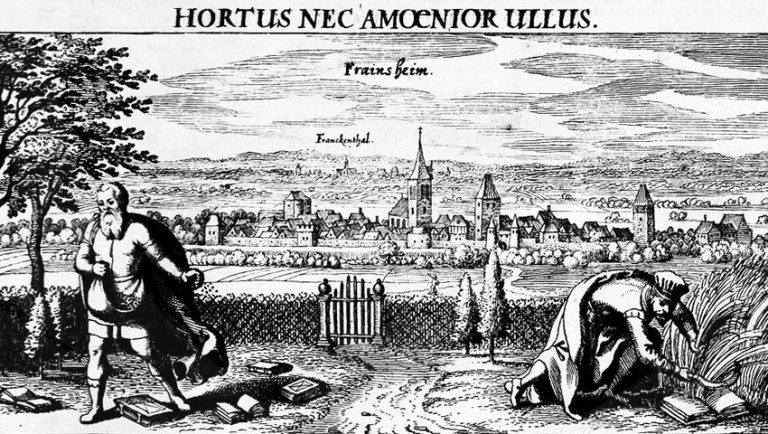
I send you a new engraving entitled…
…HORTUS NEC AMOENIOR ULLUS
─‘No garden is more enjoyable’─
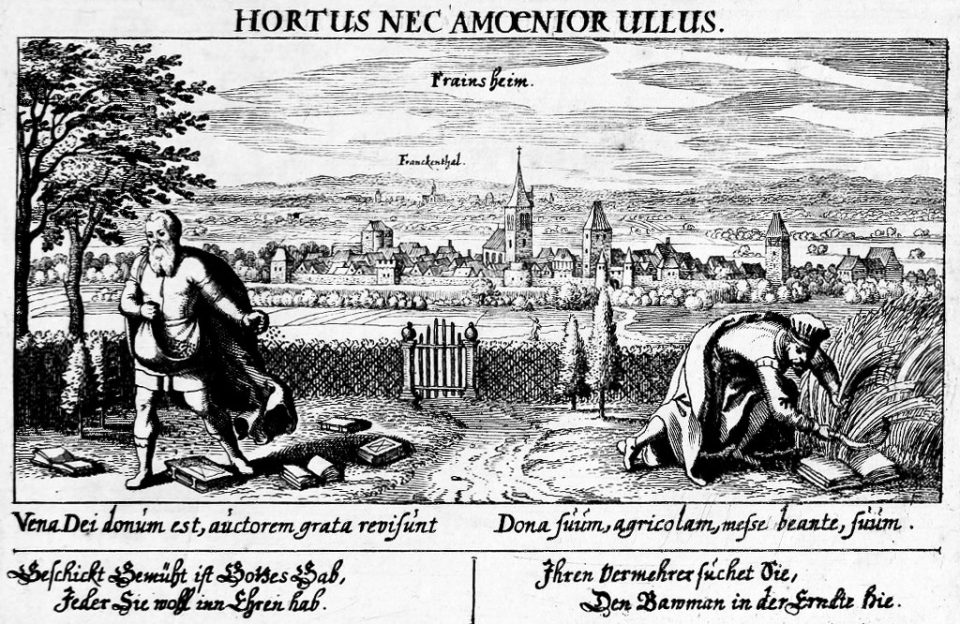
In the Latin text at the bottom of our engraving we can read:
Vena Dei donum est, auctorem grata revisunt Dona suum, agricolam, messe beante, suum.
Translation: ‘Vital energy is a gift from God, the pleasant gifts return, with the harvest that brings wealth, to their own author, to their farmer.’
Analyzing our engraving, in the foreground on the left is a sower on whose land there are books scattered, some open, some closed, and on the right a reaper in the middle of a bountiful harvest sprouting from a book. In the background the silhouette of the city of Freinsheim, Germany.
The present artistic illustration, eminently alchemical, refers to our Philosophical Earth ─our material body or physical vehicle, with which we must accomplish the GREAT WORK─.
On that earth we see several books scattered, some closed and others open, all of which puts us in contact with the symbology of the Masters of transmutatory art. One of them, the V.M. Fulcanelli, tells us the following:
“The body of this angel, whose two wings replace the head, is covered by the seal of the open book, ornamented by the cabalistic star, and the seven words, emblem of Vitriol: Visita Interiora Terrae, Rectificandoque, Invenies Occultum Lapidem. “I then saw” ─writes St John─ “another mighty angel come down from heaven, clothed with a cloud: and a rainbow was upon his head, and his face was, as it were, the sun, and his feet were as pillars of fire. He had in his hand a little open book, and he set his right foot upon the sea, and his left foot on the earth. And cried with a loud voice, as when a lion roareth; and when he had cried out, seven thunders uttered their voices. And when the seven thunders had resounded their voices, I was about to write; and I heard a voice from heaven saying unto me: Keep under seal the words of the seven thunders, and write them not… And the voice which I heard from heaven spake unto me again, and said: Go and take the little open book which is in the hand of the angel who standeth upon the sea and upon the earth. And he said unto me: Take it and eat it; it shall make thy belly bitter, but it shall be in thy mouth sweet as honey”.
This product, allegorically expressed by an angel or by a man ─the attribute of the evangelist St Matthew─ is none other than the Mercury of the Philosophers, double in nature and quality, partly fixed and material, partly volatile and spiritual, which suffices to begin, achieve and multiply the work.” […]
“But we have to make another remark. Under the Latin name liber and under the image of book, adopted to qualify the matter, withholder of the solvent, the sages meant to designate the closed book, the general symbol for all crude mineral or metallic bodies, such as given to us by Nature or such as human industry delivers to the market.”
In this way, friends, we come to know through Gnosis that both the closed book and the open book symbolize our creative energy, indispensable to create our occult anatomy, our internal vehicles.
Likewise, what is known as the Philosopher’s Earth is nothing else than our physical body, our own laboratory within which our mercurial energies are intelligently mixed, which, being reached in due time by the fire of our Divine Mother or Divine Lady Stella Maris, are transformed into redemptive waters that wash away all our precariousness since the beginning of time. This is the miracle of the fourth type of Mercury, a substance capable of transforming us completely into resplendent creatures in the eyes of God.
The words of V.M. Fulcanelli regarding the Philosophical Earth are interesting for our understanding. Let us see how he describes this detail in his work The Dwelling of the Philosophers:
“I will therefore say”, asserts an anonymous author, “that the matter from which the stone of the philosophers is made was immediately made when man was first created, and its name is philosophical earth… But no one knows it, except the true philosophers, who are the children of the Art”.
It is worth noting that the Adept we located on the right of our engraving is collecting from one of the open books a kind of wonderful vegetation ─the fruit of his work with the Mercury of the sages─. Hence, one of the sentences with which we begin the explanation of our engraving begins by telling us: “Vital energy is a gift from God, the pleasant gifts return, with the harvest that brings wealth, to their own author.” With these words we are being told that those of us who take care of our seed will be the ones favored by Nature itself.
I will now add a few quotations for your reflections:
“Fortune does help those who have good judgment.”
Euripides
“Fortune is like a market: you just have to wait for the price to go down.”
Bacon
“Fortune, and not wisdom, is what governs human life.”
Cicero
“Fortune is like a garment, when it is too loose it embarrasses us and when it is too tight it oppresses us.”
Horace
“Fortune fears the brave and subjugates the cowards.”
Seneca
EX AEQUO ET BONO.
─‘In a fair and good way’─.
KWEN KHAN KHU