

Esteemed readers:
We are sending you an engraving of the same book Thesaurus Philo-Politicus, published from 1623 by the poet Daniel Meisner (1585-1625) and the engraver and publisher Eberhard Kieser.
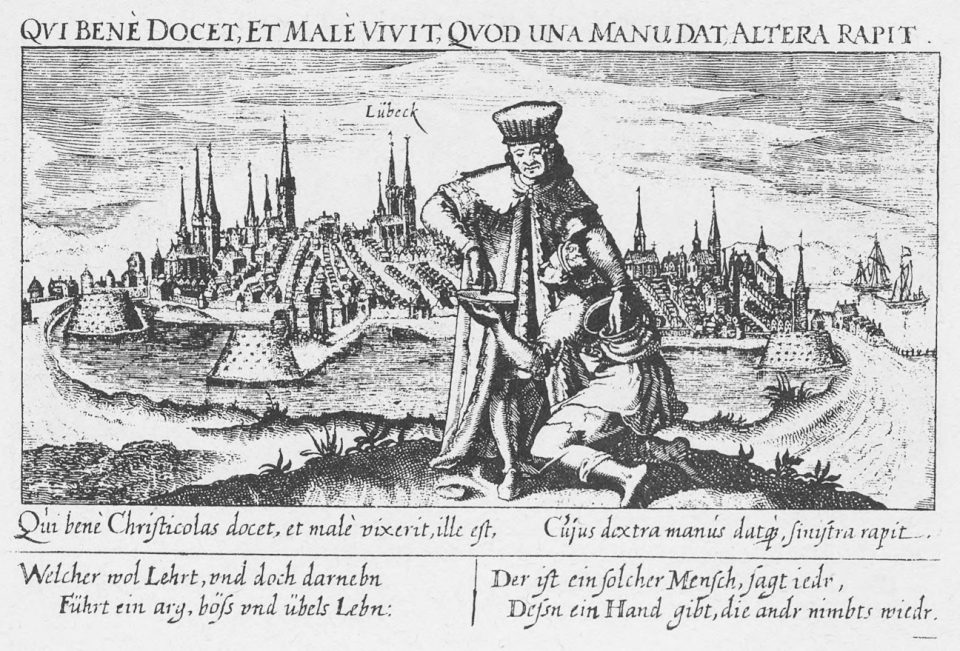
Its Latin title is Qvi bene docet, et male vivit, qvod vna manv dat, altera rapit. At the bottom of the image appears the text: Qui bene Christicolas docet, et male vixerit, ille est, Cujus dextra manvs datq[ue], sinistra rapit.
Both texts are translated as: ‘He who teaches [Christians] well, but lives badly [leads a bad, wicked and perverse life].’ The Old German text says the same thing: ‘What he gives with one hand, he takes away with the other.’
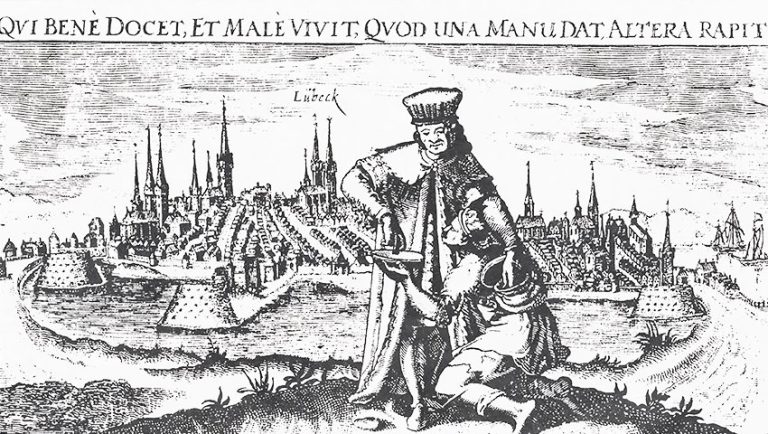
Against the backdrop of the city of Lübeck ─northern Germany─, a man dressed in the clothes of a cleric or scholar seems to perform an act of charity toward a beggar, but while he gives with his right hand, he takes back what he has given with the other.
Friends, this illustration shown in this engraving points out to us the nefarious presence of the psychological aggregate of selfishness and greed in our psychic anatomy.
In today’s world this psychological aggregate is very present and it is very easy to perceive it in our society. The most unfortunate thing is that this energetic malformation is seen represented in the actions of many clerics of our day, who, in exchange for promising a “plot in heaven” after death, take possession of the properties of those sincere Christians who practiced that faith throughout their lives. These were called “divine indulgences!” in their time.
Undoubtedly, this is a joke in very bad taste, a deception filled with evil, because in such a case we are playing with the good intentions of the aggrieved party, who, in his good faith, thinks that, in addition to being forgiven for all his sins, once he is dead he will be received by the divinity, who will place him in paradisiacal regions for all eternity. This is the same tale of many other religions that promise their followers, after their death, to be received by beautiful maidens in the midst of an ambience of unparalleled beauty also for all eternity.
Why deceive the multitudes with these tricks? Why promise the peace of heaven to lost souls if during their lives they dedicated themselves to doing evil? Is God blind, ignorant, or stupid enough to believe these farces of ours, the humanoids? Why do we play around with sacred texts by adulterating them in their original phrases? Enigmas, enigmas, enigmas…!
The mentality of the present-day humanoid is malicious par excellence, and this leads clerics and non-clerics to believe that they can deceive DIVINE justice. This also leads us to believe that hell and karma do not exist. There have already been popes who denied the existence of the infra-dimensions claiming that these hells are simply states of psychic disorder that we have been accumulating in our lives. With these affirmations the “servants of God” wash their hands.
This is the last straw!, and a declaration of sheer ignorance.
The trap of selfishness and greed has many disguises to present itself to the multitudes. In our world, today, there are many organizations that, instead of caring for the elderly in places supposedly specialized in providing them with well-being, they are, on the other hand, robbing them -under various pretexts- of their inheritance, their assets, their properties, etc., etc., etc., all justified by the claim of providing compassionate care for the terminally ill.
This type of business has spread to many places on our planet, especially in those countries that we call “civilized”…
I now give you some quotations for reflection:
“The greedy hoard as if they were to live eternally, and the spendthrift squander as if they were going to die.”
Aristotle
“Greed corrupts happiness, honesty, and all other virtues.”
Sallust
“Greed is like a flame, whose intensity increases in proportion to the fire that it produces.”
Seneca
“Greed is the desire to accumulate, either grains, or furniture, or funds or curiosities. There were misers before the invention of gold.”
Voltaire
“Greed takes away from others what it denies itself.”
Seneca
ABYSSUS ABYSSUM INVOCAT.
─‘One abyss calls another abyss’─.
KWEN KHAN KHU