

Dearest friends:
The title of this engraving reads as follows:
REVELATION DES MYSTÈRES DES TEINTURES ESSENTIELLES DES SEPT MÉTAUX
─’Revelations about the mysteries of the tinctures of the seven metals’─
In 1646, a book written by the Norman Protestant physician and alchemist Jean Brouaut (1550-1646) was published posthumously, called Traité de l’eau de vie ou anatomie théorique et pratique du vin, divisé en trois livres, sometimes translated as The Books of Distillation ─it contains three parts─.
Scholars have said in this regard:
“An exceptional and intriguing book, as stated by the Bulletin du Bibliophile in 1857, which is not simply, as its title might suggest, a scientific theory on the manufacture and properties of wine; it is an exhaustive study of the art of distillation from an hermetic perspective. We will therefore consider this treatise among the most valuable writings on alchemy.”
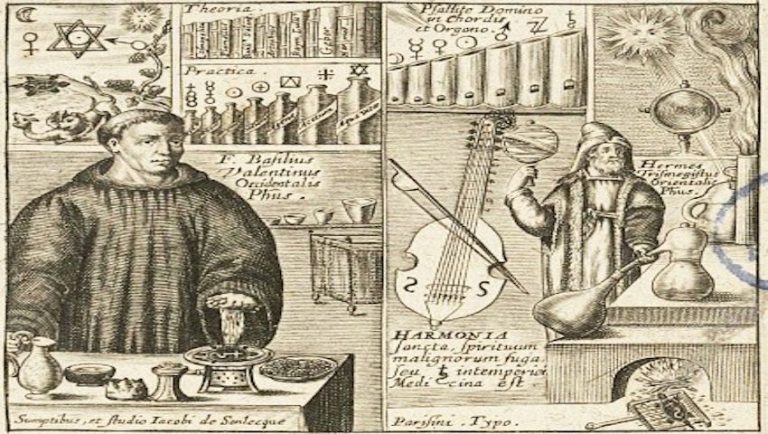
The illustrations in the book include a vignette on the cover engraved by Jacques de Senlecque (1572-1648), a French printer, engraver and alchemist, depicting Basil Valentine and Hermes Trismegistus with alchemical and musical instruments; twelve woodcuts within the text that show alembics and various alchemical tools; an engraving by Senlecque with seven emblematic medallions and at the end an alchemical drawing in the form of a shield. I attach the image of the cover:
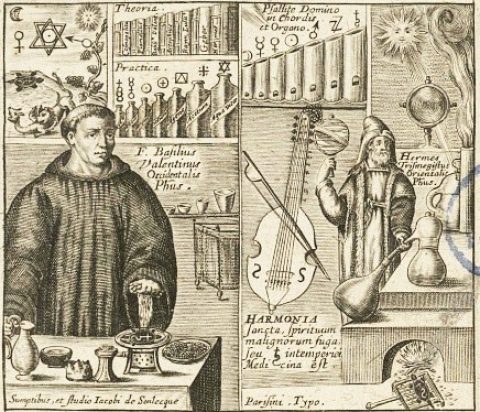
Written below: Sumptibus, et studio Iacobi de Senlecque/ Parisini. Typo, ‘At the expense and thanks to the efforts of Jacques Senlecque/ printed in Paris’.
As far as we can tell, in reference to the bottles shown in this engraving is written Med, which refers to the universal medicine or Mercury of the philosophers. The second of these bottles has Chaos writtenon it in allusion to alchemical chaos. In its upper part you can see the symbols of the planets Mercury and Venus inverted. On the third bottle you can read Ferment, which would be equivalent to Fermentum, which means ‘ferment’. On the fourth bottle you can read Patiens ─’patient’, ‘tolerant’─.
In the fifth bottle we can see the word Agens ─’active’, ‘effective’─.
The sixth has the word Acetum ─’vinegar’─.
Finally, in the seventh bottle there is Aqua Vitae ─’water of life’ or ‘water of life’─ in other words, Sulfurous Mercury, which is the main argument of Jean Brouaut’s work The Distillation of Aqua Vitae.
We add this comment:
“The name l’eau de vie comes from the medieval Latin expression aqua vitae, in Latin, literally, ‘water of life’, which referred to a liquid elixir obtained by distillation, the “essence” or “Spirit of substances” by means of which “human lead” could be transformed into “philosophical gold”. It was the fundamental element in the Great Work, in other words, the process to create THE PHILOSOPHER’S STONE.”
Curiously, the same engraving would be used 22 years later, in 1668, as the cover of another book printed in Paris, this time written by Basilio Valentín, entitled Révélations des mystères des teintures essentielles des sept métaux ─’Revelations of the mysteries of the essential tinctures of the seven metals’─.
Description:
The drawing or engraving is divided horizontally into two sections. On the right we see Hermes Trismegistus, described as Orientalis Phus ─phus being an abbreviation for philosopher─, holding an astrolabe ─an ancient astronomical instrument that represented a flat projection of the celestial sphere─ in his right hand while adjusting a distillation apparatus located on a furnace with his left hand.
We must clarify to our readers that the instrument that Hermes Trismegistus holds with his left hand symbolizes the union of the masculine-feminine sexual alchemical connection, which is why this instrument is placed on a furnace. The furnace represents the erotic-sexual fire of the alchemical couple.
Behind him we see an alembic heated by the sun’s rays focused through a lens. The alembic signifies the gestation of the Sacred Fires in the womb of our Mother Stella Maris. We can notice that a fire is burning in the furnace and next to the opening there is a rack on which a black turtle with the symbol of Saturn is located. This turtle alludes to the raw Mercury, so it must suffer the effects of the fire of the said furnace.
On the other hand, to the left of Hermes we see a viola da gamba, and above it a set of organ pipes tuned to the seven planets. The highest note ─the shortest pipe─ is the Moon, followed by Mercury, Venus, Sun, Mars, Jupiter and Saturn which is the lowest note, with the longest pipe. These pipes represent the musical notes according to which the alchemical work must be developed over time. That is why the text on the pipes reads: Psallite Domino in Chordis et Organo, ‘Sing to the Lord with strings and the organ’. That is, the work is accompanied by the action of the verb through the use of mantras.
Under the viola da gamba is the text Harmonia Sancta, Spirituum malignorum fuga seu intemperiei Medicina est, ‘Sacred harmony drives away evil spirits; or Saturn –inner death– is the medicine for intemperance’. This means that alchemical mantras drive away the bad vibrations of the evil spirits, all of this coupled with work on our psychological aggregates.
On the left, Father Basil Valentine is described as the “Philosopher of the West”, f. Basilius Valentinus Occidentalis Phus. He is standing at a table on which several containers are located. Among them is a small one on which is a black turtle with the symbol of Saturn. Basilio seems to extract the liquid from the grape that is in a dish near him with his hand. We see the drops of liquid falling on the turtle. All this is very significant, because in many cultures the turtle alludes to the inertia that keeps the waters of the alchemist in their blackness. That is why Basilio Valentín drips the drops of wine on the turtle, to invite us to change the nature of our primordial matter.
On the left, above his head, is an alchemical emblem. It shows a Sun and a Moon. These symbols represent man and woman, as well as the symbols of Venus and Mars, all arranged around two interlocking triangles that enclose a solar disk. This is the Star of Solomon or Star of David, which allegorizes the Great Work.
On the other hand, a lion attacks and is about to devour a dragon. This is the union of the fixed ─the lion, the fire─ with the volatile ─the dragon, the Mercury─.
On the upper hill we see a turtle with the symbol of Saturn, while on the right grows a vine with grapes. We have already commented on the latter.
On the right, above Basilio’s head, is written Theoria, books containing stories of Alchemy by authors such as Hermes, Geber [Jabir ibn Hayyan, Persian philosopher], Raymond Lull, Artephius [Andalusian alchemist], Basil Valentine, Flamel and the Cosmopolitan [possibly referring to Sendivogius, Polish alchemist]. The “Practice”, below, contains bottles with alchemical substances: Aqua Vitae, Acetum, Agens, Patiens, and Ferment; the labels of the latter two are difficult to read. On the bottles are their alchemical symbols. Obviously, the liquids contained in these bottles allude to the transformations that our Mercury undergoes until it becomes water of life. These are presented, like organ pipes, in a series of descending sizes.
I now add a few quotations for your reflections:
“He who habitually likes solitude without it being for devotion or study, either has a bad temper or is very unhappy.”
Bottach
“You’ll be sad if you’re alone.”
Ovid
“The man who wants to contemplate the glory of God on Earth face to face must contemplate this glory in solitude.”
Edgar Allan Poe
“Solitude is to the spirit what diet is to the body.”
Vauvenargues
“There is no solitude or man, if the soul knows how to take advantage of his body and the body of its soul.”
Quevedo
“A solitary life deprived of associates is contrary to man’s happiness and repugnant to nature, since man by his nature is a sociable animal.”
Aristotle
EX ASTRIS SCIENTIA.
─’From the stars comes knowledge’─.
KWEN KHAN KHU