

Dearly beloved friends:
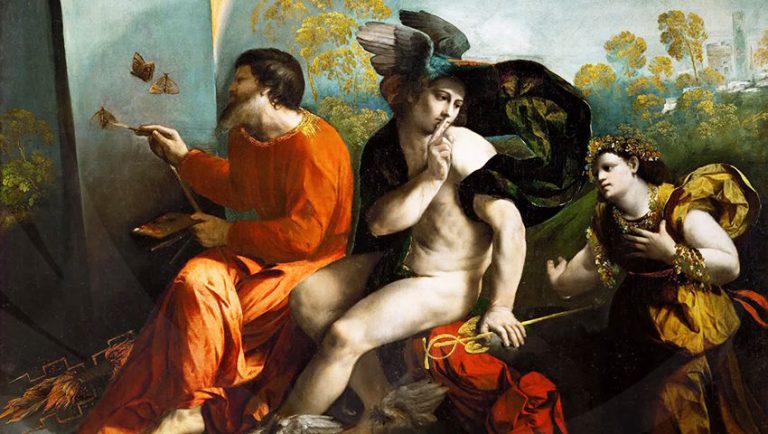
I am pleased to bring you, on this occasion, this beautiful artistic work by the Italian Renaissance painter Dosso Dossi (1489-1542). The painting is preserved in the Royal Castle of Wawel, Krakow. This work is entitled…
…MERCURY AND VIRTUE
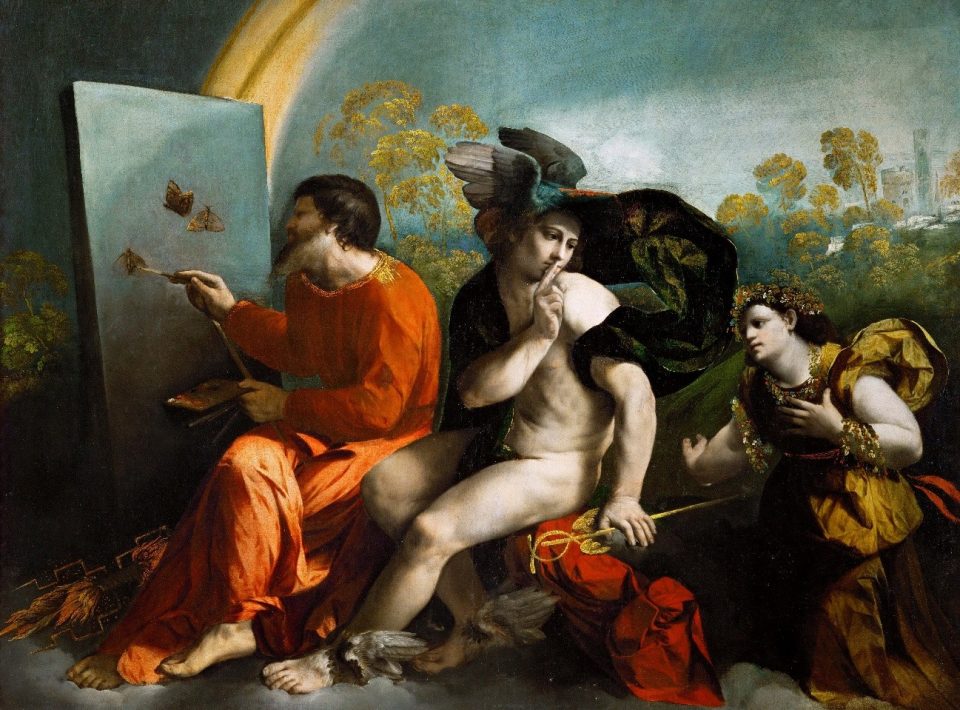
Historians comment that the theme derives from a dialogue of the deities, present in a collection of eleven books entitled Intercoenales. The collection is made up of dialogues, dreams, fables and allegories, written by Leon Battista Alberti (1404-1472), an Italian architect, mathematician and poet, personal secretary to three popes: Eugene IV, Nicholas V and Pius II, considered one of the most multifaceted and important humanists of the Renaissance.
In this dialogue, Virtue wants to complain to Jupiter about the mistreatment to which she is subjected by the humans and by Fortune. The painting was commissioned to Dosso by Alfonso del Este, Duke of Ferrara, whose face resembles that of Jupiter in the painting.
We add the translation of the dialogue from Latin into Spanish, done by the Spanish poet Bartolomé Leonardo de Argensola.
“VIRTUE.─ You see how broken I am and full of mud; you know that the cause of this has been Fortune’s presumption and lack of truth. I was at peace on the Elysian Fields, well accommodated with my elders Plato, Socrates, Demosthenes, Cicero, Archimedes, Polykleitos, Praxiteles, and other learned and excellent men, who, while they lived, reverenced me above all things, and granted me due esteem. And being with all these and other illustrious persons who came to me to greet me, that arrogant, rash, presumptuous, drunken, and dissolute Fortune comes toward us, surrounded by a large crowd of soldiers with haughty steps; and so, pompously, she comes to me and says: “O plebeian goddess, will you not make obeisance from afar to the great Gods, when you see them coming?” I felt these words keenly, and so, somewhat troubled, I answered her: “You could never make, O great goddess, that I should be a plebeian, and in case I should yield to the greatest, your power will not extend so far that I humble myself to you… At this time that great philosopher Plato began to speak of the proper office with which the persons of the Gods were to be revered; but she, angry, “take away there”, she said, “that nonsense of yours, for it is not right for servants to meddle in defending the causes and differences of the Gods.” Cicero also wanted to give some good reasons for persuading the same thing as Plato, but Mark Antony, who looked like a valiant gladiator, came out of that company of armed people, and, raising his arm up, planted a prude in the face of Marcus Tullius, who, and all those friends of mine, being frightened at this, turned their backs and fled. For you see that neither Polykleitos with his brush, nor Phidias with his chisel, nor Archimedes with his quadrant, nor all the others without weapons could defend themselves against those men who were daring and armed and experienced in war and accustomed to commit murders. On this occasion, when I was miserable, and abandoned by all, those ferocious men charged upon me with prudes and kicks, and stripped me of my garments and threw me into the mud, and, leaving me in this way, went away laughing so proudly that it seems that they triumphed over me and all my things. But I, being harassed and pursued in this way, when I was able to come to myself a little, determined to come up here to complain to the most powerful and most righteous Jupiter. I have come up, you see, and praise be to him. For a whole month now, I have been waiting for someone to introduce me in there, and I have not ceased to beg all those who come and go to negotiate a brief audience for me, and they always give me some excuses for an answer. Sometimes they tell me that the Gods are busy, that the pumpkins bloom at the right season, and others say that all the butterflies are born with well-painted wings. Therefore, O Mercury, since you are the chief messenger of the Gods, I beg and beseech you, not once but many times, to embrace this most just and most honest cause of mine; I make you the head and patron of it. I beg you to accept it; in you my hope is placed; do not despise me, for if they see me so ignominiously despised by you Gods, men will lose respect for me, and even the college of the Gods will find little honor to allow these little men, even if I were the most infamous of the deities, to esteem me so little that they make the mockery of me that I have told you.”
─Dialogue of Mercury and Virtue, p. 116─.
What does this whole narrative mean, patient reader?
It means that, certainly, the divine forces are constantly in struggle with human acts. For this reason, the God Mercury is poetically shown to us in a dialogue with VIRTUE.
Obviously, she, Virtue, is often despised by human ego-centrism and reviled ad nauseam. She, Virtue, as a sacred part of our own BEING, is forced to seek her place in our psychic continent and, curiously, when we are told that MERCURY is the messenger of the Gods, it is because in truth our MERCURY, our creative energy, is the only energy that can put us in contact with the Gods and the sacred parts of our own BEING, bringing us animic and psychic balance. Therefore, virtues feed on MERCURY itself. Where there is no Mercury, there is only violence, pedantry, mockery of the virtuous, animic abandonment, etc., etc., etc.
Jupiter takes the place of our BEING here and we see Him delighting in what is beautiful, in peace, in that which brings us light and Consciousness.
I now send you a few quotations for your reflection:
“Dignity is not about our honors, but about the recognition of deserving what we have.”
Aristotle
“Even if we lose all our possessions, let us keep our honor immaculate.”
Walter Scott
“Honor is pure crystal that breaks with a breath.”
Lope de Vega
“That man who loses his honor for the sake of business loses the business and his honor.”
Quevedo
“Honor is an essence that is not seen, often honor is seen in those who do not have it.”
Shakespeare
HOMO DOCTUS IN SE SEMPER DIVITIAS HABET.
─‘A learned man always has riches in him’─.
KWEN KHAN KHU