

Cognitio: Apollo, Pallas Athena, and the Nine Muses, VM Kwen Khan Khu

Cognitio

Cognitio 850 480 V.M. Kwen Khan Khu

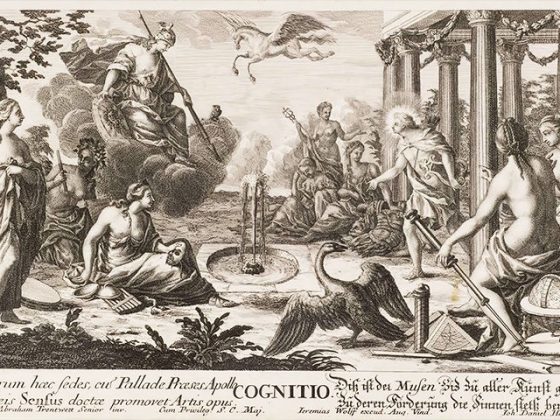
I am pleased to send you this engraving entitled: Cognitio. The scene, allegorical and mythological, shows us the seat of the nine muses on Mount Helicon, presided over by the Gods Apollo ─identified by his luminous aura and his harp─ and Pallas Athena ─who appears in the upper left corner on a cloud, with a helmet and a spear.

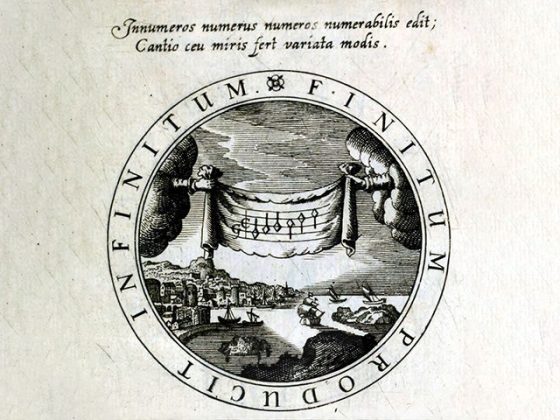
The finite produces the infinite, Jakob Bornitz

“Finitum producit infinitum” (The finite produces the infinite)

“Finitum producit infinitum” (The finite produces the infinite) 850 480 V.M. Kwen Khan Khu

We can see a cloth on which musical notes are written, giving us to understand that the basis of creation lies in them and in the octaves that we can perceive. This is one of the mysteries that surround the THEOMEGALOGOS Himself.

Mutual metamorphosis of things, Jakob Bornitz

“Mutua rerum metamorphosis” (Mutual metamorphosis of things)

“Mutua rerum metamorphosis” (Mutual metamorphosis of things) 850 480 V.M. Kwen Khan Khu

This engraving is telling us what the true Masters of the Hermetic Art affirmed and continue to affirm: “In the water the fire sleeps”…

Mercury and Virtue, Dosso Dossi, Krakow

Mercury and Virtue

Mercury and Virtue 850 480 V.M. Kwen Khan Khu

I am pleased to bring you, on this occasion, this beautiful artistic work by the Italian Renaissance painter Dosso Dossi (1489-1542). The painting is preserved in the Royal Castle of Wawel, Krakow.

Revelations about the mysteries of the tinctures of the seven metals, Jean Brouaut

Revelations about the mysteries of the tinctures of the seven metals

Revelations about the mysteries of the tinctures of the seven metals 850 480 V.M. Kwen Khan Khu

The cover depicts Basil Valentine and Hermes Trismegistus with alchemical and musical instruments; twelve woodcuts within the text that show alembics and various alchemical tools; an engraving by Senlecque with seven emblematic medallions and at the end an alchemical drawing in the form of a shield.

Divine and human symbols of pontiffs, emperors and kings

“Symbola divina & humana pontificum, imperatorum, regum” (Divine and human symbols of pontiffs, emperors and kings)

“Symbola divina & humana pontificum, imperatorum, regum” (Divine and human symbols of pontiffs, emperors and kings) 850 480 V.M. Kwen Khan Khu

I am sending you an image that appears in the book Symbola divina & humana pontificum, imperatorum, regum ─’DIVINE AND HUMAN SYMBOLS OF PONTIFFS, EMPERORS AND KINGS’─ published in 1601 in Prague.

With virtue as a guide, with luck as a companion, Gabriel Rollenhagen

“Virtute duce comite fortuna” (With virtue as a guide, with luck as a companion)

“Virtute duce comite fortuna” (With virtue as a guide, with luck as a companion) 850 480 V.M. Kwen Khan Khu

We must mortify and decompose this earth, which amounts to killing the griffin and fishing the fish, or separating the fire from the earth, the subtle from the gross, “gently, with great skill and prudence”, as Hermes teaches in his Emerald Tablet.

United virtue is stronger, Baro Urbigerus

“Virtus unita fortior” (United virtue is stronger)

“Virtus unita fortior” (United virtue is stronger) 850 480 V.M. Kwen Khan Khu

It is the frontispiece of a book published in 1690 in London and entitled Aphorismi Urbigerani. This engraving takes us back again to the study of the Sacred ARCANUM A.Z.F. and its alchemical concomitances.

Mercury, Alchemy, Johan de Monte Raphaim

Mercury

Mercury 850 480 V.M. Kwen Khan Khu

This engraving, patient reader, brings to mind one of the most precious symbols of Alchemy; we refer to the Mercury of the sages.

Virtue does not know how to fall and Wherever it is taken, Selectorum Emblematum

“NESCIT LABI VIRTUS” (Virtue does not know how to fall) and “QUOCUNQUE FERAR” (Wherever it is taken)

“NESCIT LABI VIRTUS” (Virtue does not know how to fall) and “QUOCUNQUE FERAR” (Wherever it is taken) 850 480 V.M. Kwen Khan Khu

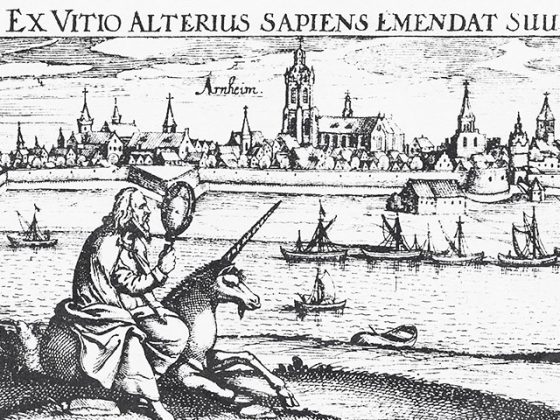
On this occasion I send you two emblems from the same book: Selectorum emblematum, with the text in Latin and Old French.