

Dearly beloved readers:
I am pleased to send you this engraving entitled…
…COGNITIO
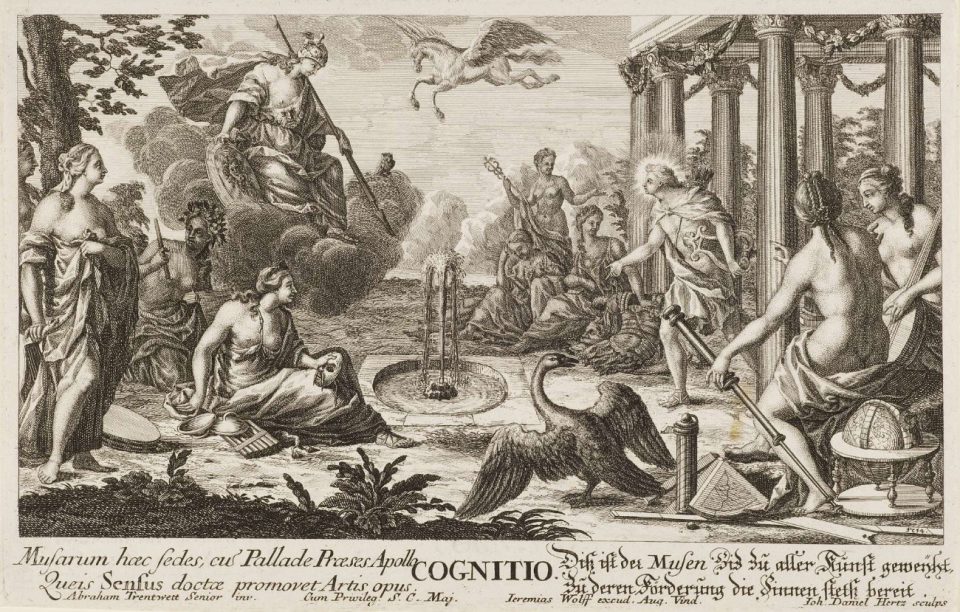
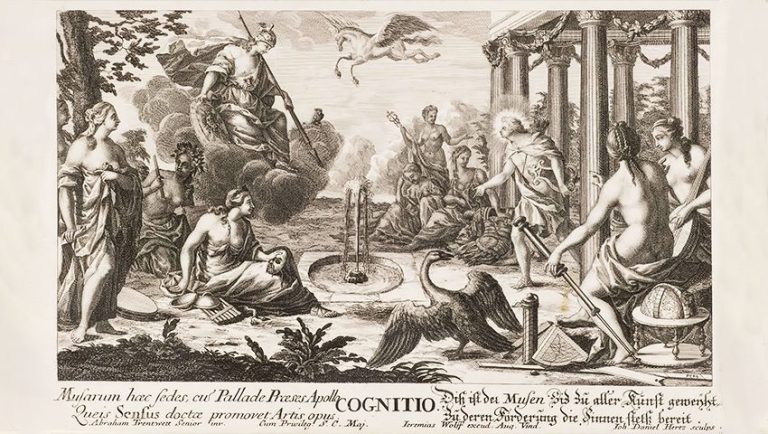
The scene, allegorical and mythological, shows us the seat of the nine muses on Mount Helicon, presided over by the Gods Apollo ─identified by his luminous aura and his harp─ and Pallas Athena ─who appears in the upper left corner on a cloud, with a helmet and a spear─.
The muses are represented and surrounded by the attributes of the arts and sciences: musical instruments, a globe of the Earth, a compass, the Caduceus of Mercury, measuring instruments… They are united around their source of inspiration, the spring of Hippocrene. According to Hellenic mythology, this spring sprang forth from a stoke by Pegasus’ hoof on Earth on the Mount of Helicon, and it bestowed the gift of song upon anyone who drank from its waters. Pegasus was a winged, indomitable horse, born from the blood of Medusa when she was beheaded by Perseus. Athena, with the help of golden bridles, tamed it and gave it to the hero Bellerophon so that he could destroy Chimera, which was besieging the region of Lydia.
In the centre of the composition, there is also a swan, Apollo’s sacred animal.
A Latin text:
Musarum Haec sedes, cu Pallade Praeses Apollo, Queis Sensus doctae promovet Artis Opus.
Translation: ‘This is the seat of the muses. The one who governs it is Apollo together with Pallas (Athena), thanks to whom sensibility promotes the work of erudite art’.
Below this text appear the notes:
Abraham Trentwet Senior inv. ─invenit─
Cum privileg. S. C. Maj. ─Sacrae Caesareae Maiestatis─
What is meant by all this, dear friends?
First, we have to go to the origin of this whole context. Let us begin by identifying the Divine Athena ─our inner Divine Mother ─, who, together with Apollo ─living representation of our intimate Christ─, governs the divine dwellings that are the property of our Real BEING. Gnosticism tells us that the nine muses are autonomous and self-conscious parts of our own BEING and, therefore, when the Father so desires, they express themselves in the spiritual nature of every Adept.
It is clear that each of them has its essential faculty that can manifest itself as music, poetry, wisdom, science, etc., etc., etc. It is the muses who have manifested themselves through the great works of a Beethoven, a Velázquez, a Michelangelo Buonarroti, a Leonardo da Vinci, a Cervantes, a Shakespeare, a Newton, a Bécquer, a Rubén Darío, etc., etc., etc.
On the other hand, we must point out that Pegasus is the living allegory of our sacred Mercury, and, for this reason, being wild, yet our blessed Stella Maris is able to tame it, giving it, likewise, different gifts or powers that such a substance carries in its own nature. Therefore, when such a creature ─the Pegasus─ hits our Philosophical Earth with its hoof, then a precious water ─the Sulfuric Mercury─ begins to flow, and everyone who drinks from this water acquires the gift of being able to interpret “the songs of wisdom”.
Pegasus emerges from the alchemical waters when Medusa ─the EGO─, has died, and therefore it is endowed with “wings”, since it has become a volatile matter when it is fecundated by the fire of the Divine Lady.
Equally important is the swan, which is Apollo’s favorite animal. The swan, for its splendid beauty and immaculate whiteness, represents the chastity of our glorious Lord ─the intimate Christ─. For this reason, we see it as part of this artistic ensemble.
We must say that only the secret Mercury can kill that monster that mythology calls Chimera.
Chimera always tries to keep humanity confused and immersed in absurd dreams, in other words, the human mind is numbed by egoic chimeras, preventing the human being from experiencing the celestial truths of the superior worlds of Consciousness.
In the beautiful artistic engraving the nine muses can be seen, although one of them is behind another who is close to a tree. Singularly, we can see one of them resting on the ground, holding a mask in her hands to represent the theater with its dramas, tragedies and comedies.
Behold, thus, dear readers, how Hermetic art certainly has its own way of expressing itself, but only for those who are knowledgeable in the matter, that is, those who are able to see in its manifestations the secret secretorum of the Great Work.
To finish our description, I attach a few quotations to be reflected:
“Thinking is a mystery, speaking is a mystery, man is an abyss.”
Balmes
“Mystery besieges us, and it is precisely what we see and do every day that hides the greatest sum of mysteries.”
Amiel
“Adoration is a transcendental form of admiration.”
Carlyle
“The true mystic finds God in all religions.”
Ibn ‘Arabī
HIC ET NUNC.
─’Here and now’─.
KWEN KHAN KHU