

Dearest reader friends:
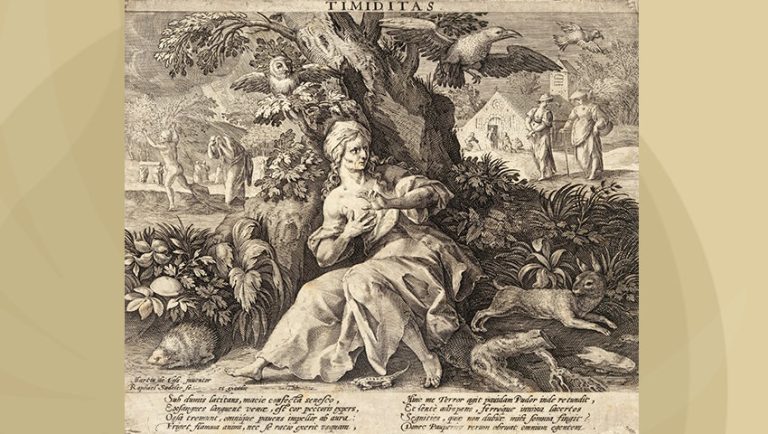
We are sending you the engraving entitled…
…TIMIDITAS
─‘Fear’─
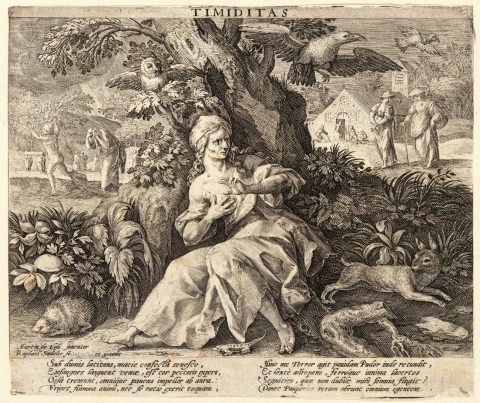
It is part of a series published by Raphael Sadeler (1560-1628) according to the drawing by Maarten de Vos.
Dictionaries explain that the word TIMIDUS derives from the Latin timaeus, ‘to fear’, and tās, which indicates a quality; therefore, TIMIDITAS would mean ‘to be afraid, fearful’.
The subject of our engraving, as on other occasions, is female, since the engraving features a woman.
Latin phrases:
Sub dumis latitans, macie confecta senesco,
Exsangues languent venae, est cor pectoris expers,
Ossa tremunt, omnique pauens impellor ab aura:
Friget flamma animi, nec se ratio exerit usquam,
Hinc me Terror agit pauidam Pudor inde retundit,
Et lente adrepens, ferroque innixa lacertos
Segnities, quae non dubiae mihi somnia fingit?
Donec Pauperies rerum obruat omnium egentem.
Translation: ‘Hiding under the brambles, devoured by thinness, I grow old, my bloodless veins languish, the heart is lacking in courage, the bones tremble, being frightened by everything [even] the breeze makes me tremble: the flame of the soul grows cold and reason is nowhere to be found. That is why terror guides me, frighteningly. Then modesty restrains me, and, slowly crawling, leaning its arms on the iron, indolence, what fantasies does it not invent for me [who am] doubtful? Until poverty oppresses [me] making me need all things.’
Description:
Looking at this engraving, dear reader, we can see four images of characters that we have indicated in bold letters.
First of all, the central figure is an elderly woman with very poor clothing. terror is represented by the two women on the left, who are fleeing; modesty is represented by the people in the background, who are seen completely covered because they are probably praying. The women on the right represent indolence. One is handcuffed; the other walks leaning on an iron rod, which is not actually a cane but a sword that she uses as a walking cane. In the background, near a church, some poor people begging for food. These represent poverty.
What are all these things, companions?
First of all, let us emphasize that, in the central part of this engraving, we observe an elderly woman with rather tattered clothes. This is human nature when it is imprisoned by the psychological AGGREGATE of FEAR or DREAD.
This elderly woman is surrounded by some animals, namely: an owl, a raven, a hare, a hedgehog, and a salamander.
The owl is representing SELF-OBSERVATION in symbology and the raven invites us to inner death, the death of our weaknesses…
The hedgehog points out our repulsive and fearful states that, unfortunately, accompany us in our daily lives.
The salamander shows us our constant fears that corner us and the hare, obviously, also represents a form of our fears.
The “I” of fear or FEAR is multiple in our psyche and is behind each of our weaknesses. Let us see, for example:
The “I” of gluttony always eats because it is afraid that one day we might be without food ─assumptions─.
Lust will always seek to be satiated because, according to it, sexual opportunities should not be missed, and this will make us indolent and weak in front of others.
Anger will always make us believe that we should not show weakness in front of our fellow men.
Pride does not want to be relegated to the background, it will always want us to show our abilities to others.
Envy will make us believe that we must imitate others to ensure a place in society.
Greed has no limits and is always justifying needs that DO NOT EXIST.
Laziness makes itself felt because, according to it, we need to rest constantly to conserve our energies, etc., etc., etc.
We could conclude the following about the two couples mentioned above: terror makes us flee, but modesty contains that impetus of fear, indolence limits action, but it has to stop when poverty, which is a consequence of indolence itself, forces us to act.
I send you a few quotations for reflection:
“Fear is painted on the face.”
Seneca
“Fear is a feeling stronger than love.”
Pliny the Younger
“Fear is the most ignorant, the most unjust, and the most cruel of counselors.”
Edmund Burke
“Fear is always ready to see things worse than they are.”
Titus Livy
“He who lives in fear will never be free.”
Cicero
MISEREOR.
─‘I have compassion’─.
KWEN KHAN KHU