

Dearest reader:
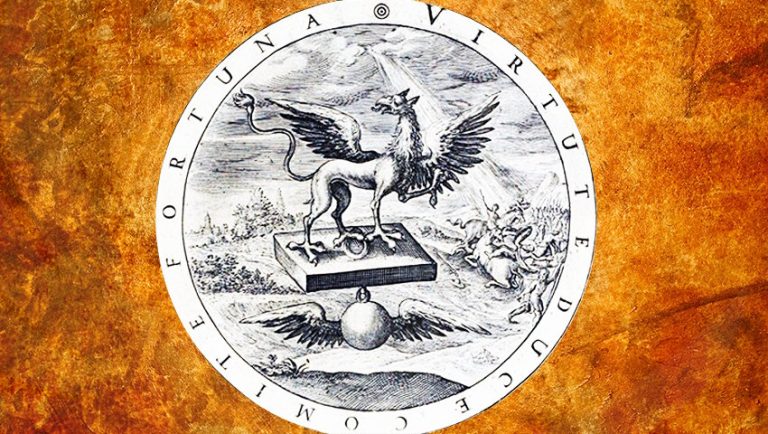
I am pleased to send you this new engraving that bears the name…
…VIRTUTE DUCE COMITE FORTUNA
─‘With virtue as a guide, with luck as a companion’─
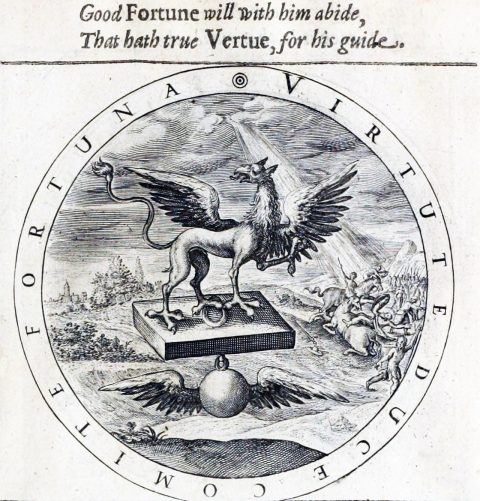
In 1635, Henry Taunton, a London publisher, hired George Wither (1588-1667), an English poet, to write verses in English to illustrate the allegorical engravings of Crispijn van de Passe (1564-1637), a renowned Dutch engraver. These allegorical engravings were originally designed for a book of emblems by Gabriel Rollenhagen (1583-1619), a German poet.
Henry Taunton published George Wither’s book as Collection of Ancient and Modern Emblems, of which the only known perfect copy is preserved in the British Museum.
The engraving I am sending you is number 139 and bears a motto in Latin and English.
VIRTUTE DUCE COMITE FORTUNA, ‘With virtue as a guide, with luck as a companion’.
Good Fortune will with him abide, That hath true Vertue, for his guide, ‘Good fortune will remain with him, if he has true virtue as his guide’.
And I transcribe for you the Spanish translation of the English text that George Wither wrote trying to explain the picture:
“The Griffin is the expression of a creature that is not found in the catalogs of nature, but was created by those ingenuities who, in order to show the internal things, drew external figures. The form expressed in this fiction was taken from a bird and a beast, incorporating – by combining its parts in this way – the virtues of both body and mind. And it is said that men ride on the backs of the Griffins when these combined virtues have dignified them.
The Stone that supports this beast can express the firmness and solidity of all true virtues. That ball of long wings, which seems to be closely linked to everything, implies the gifts of changing fortune; and all these things together mean that, when men are guided by such a virtue, good fortune cannot be separated from them. If this is true—and I believe it to be true—why should we murmur, lament, or grieve, as if our studies or our honest efforts were deprived of any deserved gain? Why should we think that the world has wronged us because we are not registered among those prosperous men who earn every day, for twelve hours of work, more than twelve months’ wages? If we cannot see the reward of our efforts, we consider our merits greater than they are. But if we conform, our value is greater. And we are rich, even if others consider us poor.”
What does all this mean, friends?
To delve even deeper into these mysteries, let us go hand in hand with the great Adept Fulcanelli, who in his The Dwellings of the Philosophers tells us the following when he wants to explain a sculptural ensemble:
On the central pillar of the second floor, a group, of certain interest to the lovers of the art and the curious about symbolism draws our attention. Although it has suffered much and today exhibits itself mutilated, fissured, and corroded by bad weather, we are nevertheless still capable of discerning its subject. It is a character holding between his legs a griffin whose paws, equipped with claws, are very apparent, as well as the lion’s tail extending from its rump, details which alone permit an exact identification. […]
We recognize in this motif one of the major emblems of the science, one which covers the preparation of the raw materials of the Work. While the combat between the dragon and the knight signifies the initial encounter, the duel of the mineral products trying to defend their threatened integrity, the griffin marks the result of the operation, veiled moreover by myths variously expressed, but all showing the characteristics of incompatibility, of natural and profound aversion which the substances in contact have for one another.
From the combat that the knight, or secret sulphur, engages with the arsenical sulphur of the old dragon, is born the astral stone, white, heavy, shining as pure silver, and which appears to be signed, bearing the imprint of its nobility, its stamp esoterically translated as the griffin, a sure indication of the union and peace between fire and water, between air and earth.[…]
We have seen how, and as a result of what reaction, the griffin is born, that comes from Hermogene or from the prime mercurial substance. Hyperion, in Greek Uperiwn, is the father of the sun; he releases, out of the second white chaos formed by the art and represented by the griffin, the soul that he holds imprisoned, the spirit, fire, or hidden light, and clears the doorway above the mass in the form of a clear and limpid water: Spiritus Domini ferebatur super aquas. For the prepared matter, which contains all the elements needed for our great work, is nothing but a fertilized earth where some confusion still reigns; a substance which holds within itself scattered light, which the art must gather together and isolate by imitating the Creator. We must mortify and decompose this earth, which amounts to killing the griffin and fishing the fish, or separating the fire from the earth, the subtle from the gross, “gently, with great skill and prudence”, as Hermes teaches in his Emerald Tablet. […]
It is useful to know that the brief but violent fight fought by the knight— be his name St George, St Michael, or St Marcel in the Christian tradition; Mars, Theseus, Jason, or Hercules in the myths— only ceases with the death of both champions (hermetically, the eagle and the lion) and their union into a new body whose alchemical signature is the griffin…”.
Having said all of the above, dear reader, our emblem encloses the conjunction of the sacred Sulfur –Fire of the Divine Mother– with the purified or whitened Mercury, all of which will redound to the splendor that our Philosopher’s Stone will opportunely have, which will make us invincible in the face of the mediocrity that surrounds the human species because of the egoic multiplicity that we carry within. Everything has always been summed up in the union that must take place between the fixed and the volatile ─the lion the fixed and the eagle the volatile─.
Hence, the ball that is connected to the griffin of our emblem is nothing else than the hermetic chaos that feeds its powers, for which this chaos carries wings, since it is our Mercury that is susceptible to be sublimated through alchemical transmutation, to end up granting us the various faculties that Hermeticism attributes to our seed.
True are the words of the engraving when it invites us to value the faculties of our sacred seed once we treat it with the mysteries of the Arcanum A.Z.F., for, although the world loves earthly things terribly, we value the things of the Spirit even when many consider us poor because we do not know the divine grace of which we become possessors. That is why we are told that if we become possessors of that stone on which that griffin rests, we shall then have made a great conquest.
That is the reason for the struggles that we see in the lower right part of the engraving, in which a figure stands out with a spear ─which is symbolic─, killing many people ─or undesirable psychological aggregates─ which deserve to be reduced to nothing.
From the sky we see, in our engraving, some beams of light that are emitted, as if helping the seeker of Truth in his fight against darkness.
Finally, I give you some quotations for reflection:
“Fortune is more contrary to the man whom it does not allow to enjoy what he has, than to the one whom it denies what he asks for.”
Plato
“God gives beans to the one who has no jaws.”
Fernando de Rojas
“The benefit of some is the harm of others.”
Montaigne
“True strength is that which makes us inflexible whenever it is a question of virtue.”
Plutarch
“Those who set their sights on virtuous ends cannot be called deceitful.”
Cervantes
FAC QUOD FACIENDUM EST.
─‘Do what must be done’─.
KWEN KHAN KHU